#

Duration: 10 Weeks | Mode: Online / Offline / Hybrid

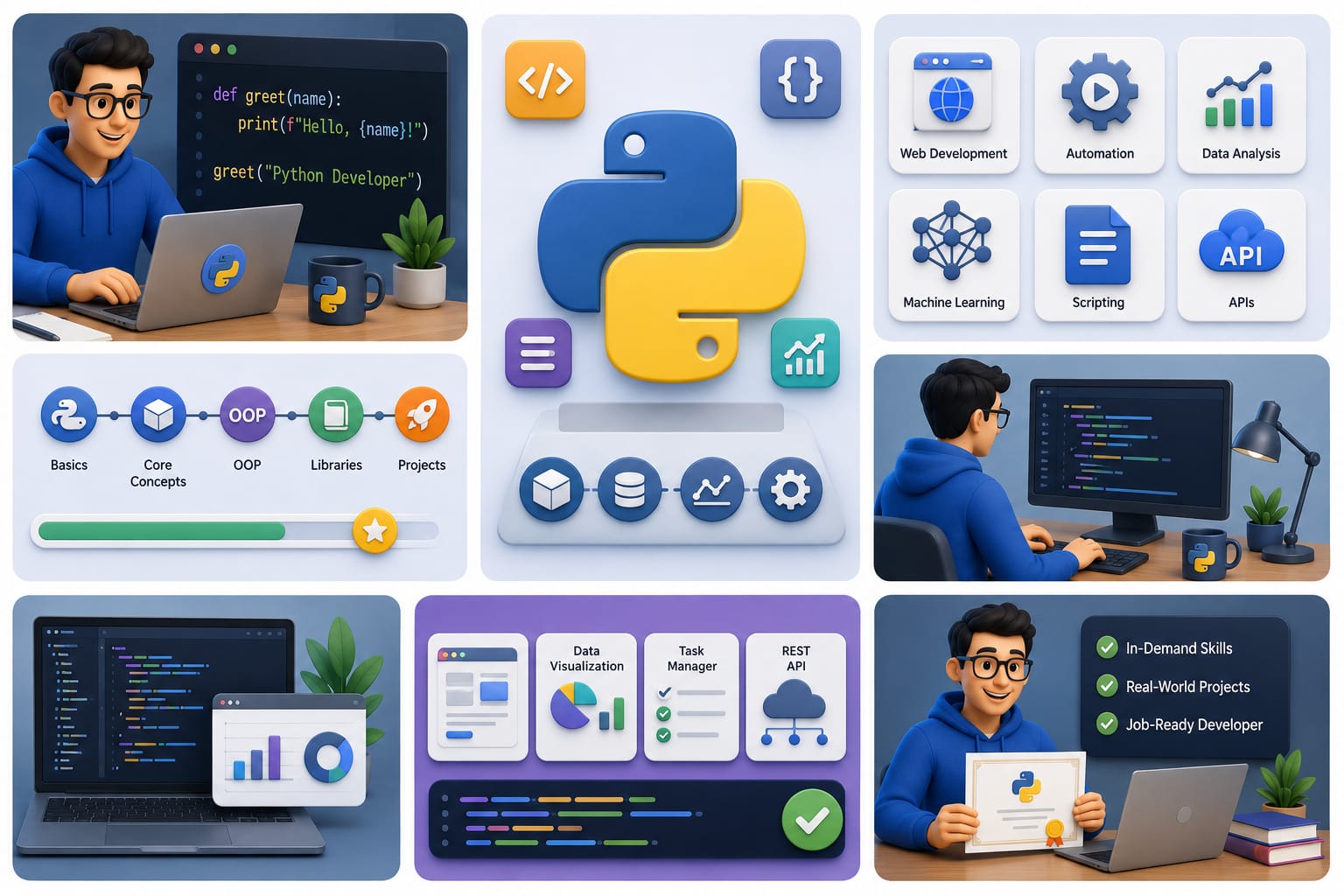
Python is consistently ranked the world's most popular programming language and for good reason. It powers web applications, automates workflows, drives data analysis, fuels machine learning models, and is the go-to language for scripting and automation in every industry. Companies from startups to tech giants are hiring Python developers, and the demand shows no sign of slowing.

This course takes you on a structured journey from your very first line of Python code to building real-world applications. There are no prerequisites - you do not need to have coded before. What you do need is curiosity and the willingness to practice every day.

By the end of this course, you will have a solid Python foundation, hands-on project experience, and the confidence to work on Python in a professional environment. Our trainer is a working Python developer who writes production code and brings real development practices into every session.

PYTHON PROGRAMMING FULL SYLLABUS

programming, automation, and data analysis skills used in real-world projects.

MODULE 1 - Getting Started with Python
  • Why Python? Use cases: web, data, automation, AI
  • Installing Python and setting up VS Code / PyCharm
  • Python interpreter: interactive mode and script mode
  • Your first Python program: print, comments, indentation
  • Understanding errors: syntax, runtime, logical
MODULE 2 - Python Fundamentals
  • Variables and data types: int, float, str, bool, NoneType
  • Type conversion: implicit and explicit casting
  • Operators: arithmetic, comparison, logical, assignment, bitwise
  • Input and Output: input(), print() formatting with f-strings
  • String operations: slicing, methods (upper, lower, strip, replace, split, join)
  • String formatting: %-style, .format(), f-strings
MODULE 3 - Control Flow
  • if, elif, else: conditional logic
  • Nested conditions and complex boolean expressions
  • Loops: for loop, while loop
  • range() function in depth
  • Loop control: break, continue, pass
  • Nested loops and loop patterns
MODULE 4 - Data Structures
  • Lists: creation, indexing, slicing, methods (append, insert, remove, sort, reverse)
  • Tuples: immutability, packing, unpacking
  • Sets: unique values, set operations (union, intersection, difference)
  • Dictionaries: key-value pairs, nested dicts, dict methods
  • List comprehensions and dictionary comprehensions
  • When to use which data structure
MODULE 5 - Functions
  • Defining and calling functions
  • Parameters: positional, keyword, default values
  • *args and **kwargs
  • Return values and multiple returns
  • Lambda functions and when to use them
  • Scope: local, global, nonlocal
  • Recursion: concept, examples, and when to avoid it
  • Higher-order functions: map(), filter(), sorted()
MODULE 6 - File Handling
  • Opening, reading, and writing text files
  • File modes: r, w, a, rb, wb
  • Working with CSV files using the csv module
  • Working with JSON files using the json module
  • Context managers: with statement
  • Exception handling: try, except, else, finally, raise
  • Custom exceptions
MODULE 7 - Object-Oriented Programming (OOP)
  • Classes and objects: concept and syntax
  • __init__ constructor and self
  • Instance vs class variables
  • Methods: instance, class methods, static methods
  • Encapsulation: name mangling and properties
  • Inheritance: single, multiple, multilevel
  • Method overriding and super()
  • Polymorphism and duck typing
  • Special methods: __str__, __repr__, __len__, __eq__
MODULE 8 - Modules and Packages
  • Importing modules: import, from...import, as
  • Python Standard Library: os, sys, math, random, datetime, collections, itertools
  • Creating your own modules and packages
  • Virtual environments: venv, pip, requirements.txt
  • Introduction to PyPI and package management
MODULE 9 - Python for Data (Intro)
  • NumPy: arrays, array operations, indexing, slicing, broadcasting
  • Pandas: Series and DataFrame, reading CSV, filtering, groupby, aggregation
  • Matplotlib: basic plotting - line chart, bar chart, pie chart, histogram
  • Real-world data analysis mini exercise
MODULE 10 - Python for Automation
  • OS and file system automation with os and shutil
  • Web scraping basics with BeautifulSoup and requests
  • Automating browser tasks with Selenium (intro)
  • Sending emails with smtplib
  • Working with Excel using openpyxl
MODULE 11 - APIs and Web Basics
  • What is an API and how HTTP works
  • Making API calls with the requests library
  • Parsing JSON responses
  • Building a simple REST API consumer application
  • Introduction to Flask: your first web route
MODULE 12 - Capstone Project
  • Option A: Student management system with file storage and OOP design
  • Option B: Data analysis dashboard using Pandas and Matplotlib on a real dataset
  • Option C: Web scraper that collects and stores data from a public website
  • Option D: Automation script to organise files, send reports, or interact with an API
MODULE 13 - Interview Preparation
  • Python interview questions: core concepts, data structures, OOP
  • Coding challenges: common patterns (list manipulation, string processing, recursion)
  • HackerRank / LeetCode warm-up problems
  • Resume tips for Python developer / data analyst roles
  • Mock coding round + technical interview simulation